

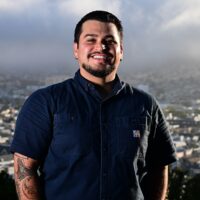
Winsor Kinkade, a nonbinary artist, has been making art as soon as they were old enough to pick up a pencil.
Painting and drawing have long served as sources of comfort. As immigration enforcement escalates nationwide, they’ve turned to art as a tool for resilience in immigrant communities.
“A lot of my work comes from deep wells of grief,” said Kinkade. “Deep wells of anger, frustration, and strong embers of hope.”

Earlier this year, the Trump administration launched a large-scale federal immigration crackdown in Los Angeles, sparking confrontations and grassroots organizing nationwide. In San Francisco, asylum seekers were detained during routine immigration court check-ins, prompting protests and clashes with police across the Bay Area.
In January, Kinkade responded swiftly. Using a red Micron marker, they sketched a flyer in a tan-toned sketchbook compiling Bay Area rapid response hotline numbers — a network of community-based immigrant rights organizations operating 24/7 to respond to suspected or confirmed enforcement actions. The hotline helps verify ICE activity and connects detained individuals with emergency legal support.
“I’m seeing all of these numbers floating around,” Kinkade said. “And it would be helpful [to have them compiled].”
After posting the flyer to Instagram, the image quickly spread online and onto the streets. Friends began sending photos of the flyer taped to storefronts and stickered along streets.


The original drawing depicts a cornfield in red tracing, a homage to Kinkade’s close relationship with farmworkers through their full-time work as a community mental health therapist with Ayudando Latinos A Soñar in Half Moon Bay. Across the top, the flyer reads: “OHLONE LAND BAY AREA ICE RAPID RESPONSE COMMUNITY NETWORKS.” Hotline numbers fill the center. At the bottom, a message in Spanish declares: “NINGÚN SER HUMANO ES ILEGAL,” finalized with a tiny red star.
For Kinkade, who identifies as queer, the artwork does not solely belong to them: “It’s ours.”
Since the artwork went public, the image has taken on multiple iterations. “People make edits to it, change the color,” said Kinkade. “I’ve been encouraging that. Make it how you want.”
Kinkade also leads an art program for farmworkers at ALAS, creating space for families to come in and paint after long days working the fields.


At a time when many artists rely on iPads and digital software, Kinkade remains committed to an analog practice. They work with paper and pen. Their oil paintings are spiritual and raw, often focusing on hands or still lifes. They favor bold, warm and earthy colors — a palette connecting to the farming towns along the Peninsula.
Earlier this year, Kinkade shared a linocut piece honoring the Indigenous Zapatista uprising in Chiapas, Mexico. The work features a large corn stalk filling the frame in bold red, and red hues. At the bottom it reads: “Tierra y Libertad” in Spanish.
Kinkade’s home is nestled along a quiet street in Pacifica. Inside, mixed-media works line the walls. Fresh paintings lean against the dining room wall. Animal furs rest on the wooden floors, and large windows flood the space with natural light.
In their studio, oil paints sit neatly besides brushes. A sewing machine stands at the center.
Recently, they’ve been organizing virtual workshops that invite artists to organize against ICE.
“Art-making for me is a source of healing,” Kinkade said. “It’s a source of critiquing [the world]. But creating art is also an opportunity to imagine, which I think is really important when the temptation to lose hope is so present. ”

Much of Kinkade’s work is shaped by current events. “My work is oriented around the idea that art is a collective testimony,” Kinkade said. “It becomes community storytelling, and a creation of an archive, in some ways, around what is currently happening, what has happened, and what could happen.”
The rapid response hotline flyer exemplifies that philosophy, arriving at a moment of urgent need for accessible resources in Bay Area immigrant communities. When art and testimony intersect, resistance takes root.

“I call this practice artemonio (arte and testimonio),” they said. “Artemonio becomes a way that we can practice everyday resistance and can be a seed of planting new futures.”
To encourage that process, Kinkade created a public art folder where people can download free community resource lists, anti-ICE flyers, posters and messages to adapt and share.
Kinkade is clear-eyed about the limits of the work. Hotline numbers alone, they said, aren’t going to stop ICE raids or detentions. But shared knowledge, art and community networks can help create systems of protection.

Sitting at their table, Kinkade reflected on the role of artists during moments of crisis, paraphrasing a quote by Maya Angelou:
“This is the time that artists go to work,” they said. “Art-making right now is a ritual of resistance. It’s a ritual of testimony and storytelling.”